
Gearflow Launches AI-Powered Procurement Platform Built For Fleet Teams

Where We Started
When we launched Gearflow, we started with parts. Not because parts is the biggest cost, but because it's the most visible pressure point for fleet teams.
A technician needs a part. Hours pass. Phone calls get made. Vendors get chased. The machine sits. The job waits.
We built Parts Hub Pro to streamline that process—purpose-built for the way fleet teams actually work, from mechanics in the field on their phones to parts managers sourcing across all of their local vendors. The feedback was immediate: shop bays turning faster, faster fulfillment, WAY fewer headaches.
Teams have shared some amazing stories - $90k saved in the first 90 days, parts managers going from all day phone calls to not a single ring, mechanics saving 12+ hours a week.
But the closer we got with our customers, the more we got pulled into the broader picture: parts is just one piece of a much bigger problem.
The Coordination Gap
Fleet teams don't just manage assets. They keep jobs running. And the gap between a job site having a need and that need being resolved is filled with a staggering amount of coordination that happens across siloed teams, disconnected systems, and overflowing inboxes.
Procurement starts at the job site
When a fleet gets to be a certain size, it's rare that the job site makes all of the equipment decisions on their own. Whether that be a repair issue, a replacement issue, or a net new asset - there are too many moving pieces and too much money at stake.
We saw, across hundreds of fleet teams, that the folks on the job site are reporting their equipment needs in one of two ways:
- They send emails to a distribution email (so it's documented) followed by a phone call (to make sure someone is on it).
- They fill out a form (that's far too long) and then make a phone call (again, to make sure someone is on it).
This is an intake problem.
The job site is being slowed down and left in the dark.
One half of the problem is how needs are reported, the other half is how expectations are communicated back.
Fleet operations is fighting the waves
“Because the mail never stops. It just keeps coming and coming and coming, there's never a let-up. It's relentless. Every day it piles up more and more and more! And you gotta get it out but the more you get it out the more it keeps coming in. And then the bar code reader breaks and it's Publishers Clearing House day.”
— Newman, Seinfeld, Season 4: The Old Man
Take an equipment breakdown.
On the surface, it's one need.
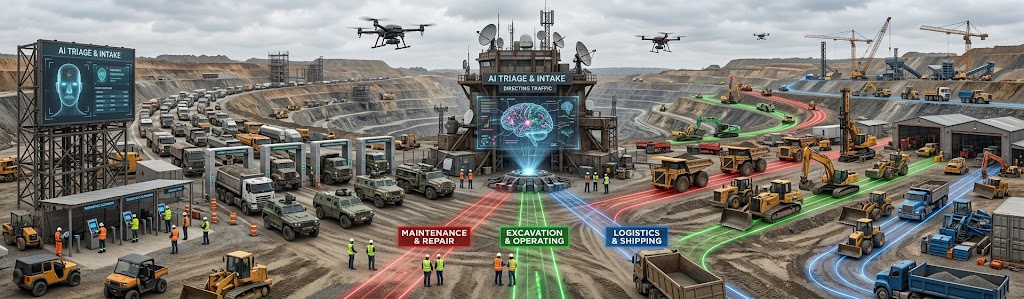
In practice, it triggers at least four separate workflows simultaneously: Dispatch needs to source a replacement asset and get it mobilized. The shop needs to assess whether the downed machine gets repaired internally or sent to a vendor. Parts needs to determine if the repair requires a purchase order or pulls from existing stock. Logistics needs to schedule trucks—for the replacement going out, and potentially the damaged asset coming in.
These four workflows are completely co-dependent. You can't optimize dispatch without knowing trucking availability. You can't finalize the repair plan without knowing parts availability. You can't schedule trucks without knowing what's actually ready to move. But today, most fleet teams are running each of these functions independently, coordinating through manual handoffs that lose context, slow decisions, and quietly drain margins.
And the job site needs never stop. They only increase as the business grows.
Fleet operations has a capacity problem.
We found that every fleet team managing 200+ assets had the same vulnerabilities:
- 90% of time is spent on emails, phone calls & data entry
- Anyone that does purchasing, from parts to rental equipment, is barely able to keep up
- This creates bottlenecks in the process, risking slowing things down for the job site
- There is no time left in the day to make sure the right sourcing decision is made which leads to a lot of finger pointing
So teams add more headcount...which rarely solves the problem.
The right metrics aren't there when they're needed
Every fleet team is able to track all of the key metrics and then some - utilization, equipment costs, fuel costs, idle time, mean time to repair, fair market value, you name it.
Tracking is not the problem.
A fleet manager's problem is when, and where, those metrics show up.
Most of these KPIs are only visible in a report at the end of every month, quarter, or year. Which leaves every fleet manager trying to figure out how in the world a rental asset sat unused for 90 days.
Instead, key metrics should be inserted into the workflows to inform sourcing decisions and prevent cost overruns.
If the plan to fulfill an equipment need is like giving directions to drive from point A to point B, your fleet data should be the traffic patterns that inform what route you should take and what your ETA will be.
For example, let's say a job needs another 982 sized loader because theirs is down.
- The utilization of similar loaders and the cost of mobilization compared to the rental rates nearby should be right there when the dispatcher decides where to source the asset.
- When that loader gets rented and starts to show that it is underutilized, the site superintendent knows about it as soon as it starts that trend.
- Your shop's average time to repair, your technicians' availability, and parts availability compared to the cost of 3rd party maintenance should be there the minute that equipment down is reported.
- The fair market value of your loader compared to the estimated cost of repair should be there the moment a repair decision is made.
This is hurting a fleet's ability to scale
Almost every contractor we talk to is experiencing record growth.
As the cost of iron goes up, bids get more fine tuned, and costs increase - profitability is going to have to come from operational excellence.
Whoever can keep their jobs on time and on budget more efficiently, wins.
This sounds like the perfect job for technology:
- Automate the manual repetitive tasks
- Streamline the communication
- Embed the right data into your workflows
- Reduce friction from your process
- Measure team performance
Here lies the coordination gap in every contractor's operations - stitched together by spreadsheets, generalized project management tools, and more phone calls and emails.
Why Most Software Doesn't Solve This
There's no shortage of fleet management software. And most of it is genuinely good at what it does—tracking assets, logging maintenance history, reporting on costs. These are important tools.
But here's the distinction that matters: fleet management systems and ERPs are built to track decisions, actions, and costs after they've been made.
And they are very good at that - hence why most teams have more data than they know what to do with.
However, what they are not built for is procurement - which is how contractors report, plan, source, and fulfill what a job site needs to stay running.
This requires tight coordination - bringing the right people, information, and tooling together to make fast, confident decisions hundreds of times a day.
What We're Launching
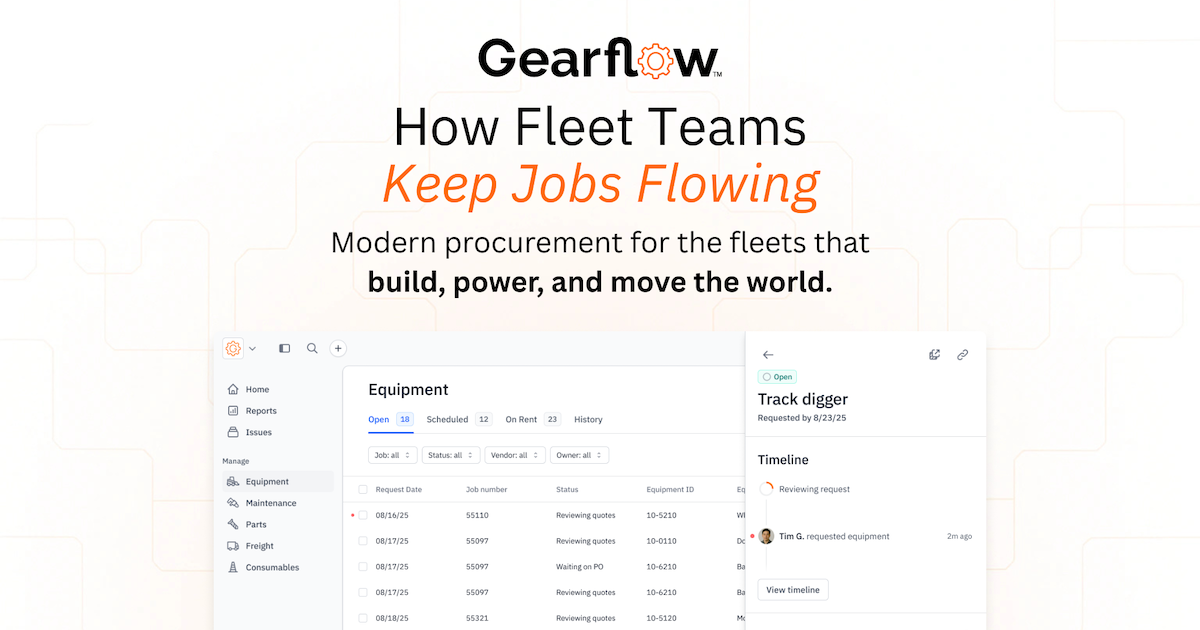
Today, we're announcing the expansion of Gearflow beyond parts procurement into the AI-powered procurement platform built for fleet teams to keep jobs running — integrating equipment, parts, service, and mobilization into a single orchestration layer.
Job site teams can submit equipment needs simply—no complex forms, no phone tag—and get real-time visibility into the status of those requests.
Site superintendents get the visibility they need to create game plans while protecting margins before spend happens.
Fleet operations gets a unified view of demand across all categories, with tooling that helps them source, fulfill, and communicate faster.
All with AI embedded natively throughout - so your team can spend time where it's needed most and decisions don't get made in a vacuum.
Come See Us At CONEXPO
The teams that win over the next decade won't necessarily be the ones with the most iron. They'll be the ones who can mobilize and manage it better than anyone else—with fewer support costs, less waste, and faster response times when the job needs something.
That's what we're building toward. And we're just getting started.
We can't wait to show you what we've been working on. Come find us at booth N11241 or schedule a demo today!


.png)