
“What’s this $2,000 markup all about”

That was the question the Moss Utilities team asked themselves when they looked through the parts order history on Gearflow. One part came in higher than expected and because it was an uncommon high value purchase they took it at face value. But now with centralized parts history they can make informed decisions. Quotes come in side by side and they can compare, review price history and use that to gain more negotiating power for future orders. Here’s how Gearflow is saving the team time and money.
Defining Success
Moss Utilities came on board with two clear goals:
- Efficiency
They want to provide mechanics with a digital way to quickly order parts, simplify part history lookup and streamline vendor communication. Their people were spending too much time on the phones and following up, taking them away from what was needed most: getting machines back up and running. - Centralizing Visibility
The team wanted to gain visibility into the cost of parts that were tied to each asset. That gives an indication on servicing costs and the potential for bulk orders across machines.
From phone calls to one workflow
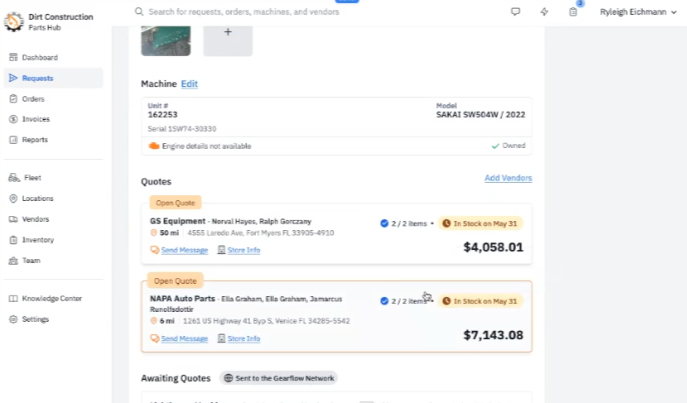
Every day, the team used to spend hours on the phone calling vendors and requesting quotes. With Gearflow, that happens in one workflow. The team creates a parts request and sees quotes come in side by side.
At a glance, they can:
1. Review the price
2. Compare the lead time
3. Confirm the parts number
It helps the team to quickly make procurement decisions and has cut the average quote time to 46 minutes, falling by 2 hours in the last 90 days. And now orders are fulfilled in 24 hours, down from nearly 5 days. But according to the team, the biggest benefit is what happens after the quote. They can generate reports showing management how much money they’ve saved through comparisons, giving the procurement team a way to make its impact visible, showing exactly how its work is saving the company time and money.
No more phone tag
When the team has a question about a part or a quote, instead of picking up the phone, they message the vendor directly in Gearflow. Each conversation is linked to the part request and order, with the vendor, mechanic and procurer tagged in the thread. There’s no jumping between phone calls, emails and texts to explain the request, and no playing phone tag with the vendor and mechanic to figure out who has the latest information. And instead of trying to describe a part over the phone or sending an email with an attachment, the team can also send schematics and images directly in the conversation. Everyone has the right context in one thread, attached to the order and visible to everyone involved.
One Click Ordering
Every parts dollar is tied to a machine. 99.8% of Moss Utilities’ parts spend lands on a named unit, giving the team a detailed history of what was bought, for which machine, at what price, and from which vendor.
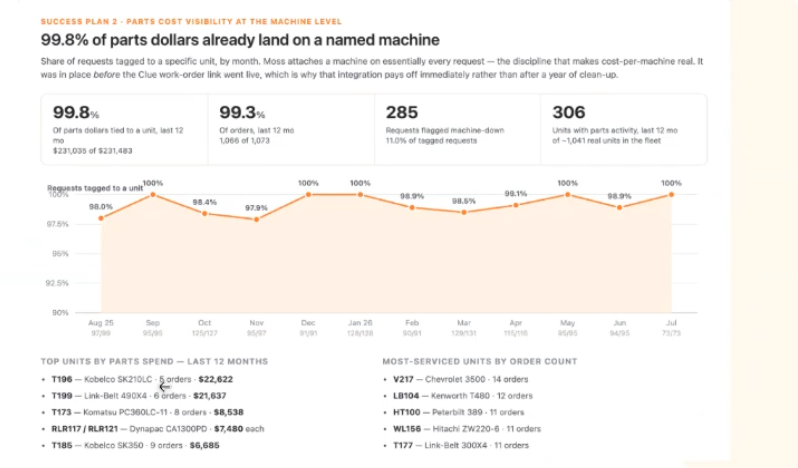
Now that every part order is tracked, the Moss Utilities team has a history of pricing, availability, and delivery times for each part. Over time, they know which vendors are best for specific parts and situations. It means that instead of checking availability and requesting quotes each time, the team can reorder in one click, with the exact part number attached. That also prevents confusion when there is a change on the vendor side. When the parts person at one of their preferred vendors transitioned, the Moss team would call the new contact and ask for a “500-hour filter kit.” Without the context of the account, the new parts person could easily send the wrong kit.
Gearflow captures the full context and sends it to the vendor, so the order is specific and the service continues as usual.
Do We Really Want to Fix This?
Once every part is tied to a machine, the team can see how much they are spending to keep each asset running. That opens up a different question: when does it stop making sense to repair a machine?
One rule of thumb the team uses is that when a repair reaches around 30% of a unit’s net book value, the machine needs high utilization to justify keeping it. Otherwise, you may be putting significant money into an asset that isn't being used enough to earn it back. There are exceptions for expensive, specialized machines, but the principle gives the team a benchmark for thinking about fleet replacement. Moss is starting to connect that decision across systems. Its Gearflow integration with Clue pushes parts costs directly into the asset's work order, alongside labor.
The goal is to get to a point where real-time parts data feeds directly into fleet strategy: identifying which machines are becoming too expensive to maintain, which are worth keeping because of their utilization, and where the next CapEx should go.
Moss isn't all the way there yet. But the path is clear: parts ordering becomes the data layer for better fleet decisions.



.png)